Why Every Independent Artist Needs a Music Release Strategy
A music release strategy for independent artists is no longer just about uploading a song and announcing it on release day. In today’s music industry, independent artists need to think about the entire journey—from preparing the release and building anticipation to promoting the song, analyzing audience behavior, and extending its lifespan after launch.
For years, releasing music was treated as a simple sequence:
Make the song → upload the song → announce the song → wait for people to listen.
That model doesn’t work particularly well anymore.
Independent artists now have access to global distribution, streaming analytics, short-form video, direct fan communication, creator collaborations, playlist pitching, audience data and publishing tools that were once difficult to access without a label.
But greater access has created a different problem: competition.
Thousands of artists can release professional-quality music without a record label, which means simply having a good song is no longer enough to guarantee that people will find it.
The modern release is therefore less about a single release day and more about building a campaign around a song.
A successful campaign creates awareness before the song arrives, gives people multiple reasons to discover it when it launches, and continues finding new listeners after the initial release-day excitement disappears.
This guide explains how independent artists can build that system.
1. Stop Thinking of a Release as a Single Day
One of the biggest mistakes an independent artist can make is treating release day as the entire marketing campaign.
The artist spends weeks recording and perfecting the song, uploads it to a distributor, waits for the release date, posts:
“OUT NOW 🚨🔥”
…and then expects the audience to take over.
The problem is that most people haven’t been following the song’s journey.
A better approach is to think of a release as having three distinct stages:
Before the release
Build awareness and anticipation.
Release week
Concentrate attention and make discovery easy.
After the release
Extend the life of the song and learn from the data.
This shift is important because your release campaign should not end when the song becomes available.
In fact, release day is where the campaign changes phases.
Spotify itself provides artists with tools specifically designed for preparation before release, including profile optimization, editorial playlist pitching and Canvas.
2. Start With the Song, But Don’t Stop There
Marketing cannot rescue a song that isn’t ready.
Before thinking about TikTok videos, playlist pitching or advertising, make sure the fundamental release assets are properly prepared.
That includes:
- Final master
- Correct song title
- Artist names
- Featured artist information
- Songwriter and producer credits
- ISRC information
- Cover artwork
- Lyrics where applicable
- Release date
- Distributor
- Artist profiles
- Promotional assets
This sounds basic, but mistakes in metadata can create unnecessary problems later.
An incorrect artist name, misplaced release or incorrect credit can affect how your music appears across platforms.
Spotify has even introduced Artist Profile Protection in beta in 2026 to give eligible artists more control over releases appearing on their profiles, highlighting how important artist identity and accurate catalog association have become.
The first part of a release strategy, therefore, is not promotion.
It’s infrastructure.
3. Give Yourself Enough Time
Don’t finish a song on Monday and decide that it should be everywhere by Friday.
A better approach is to give the release campaign several weeks to develop.
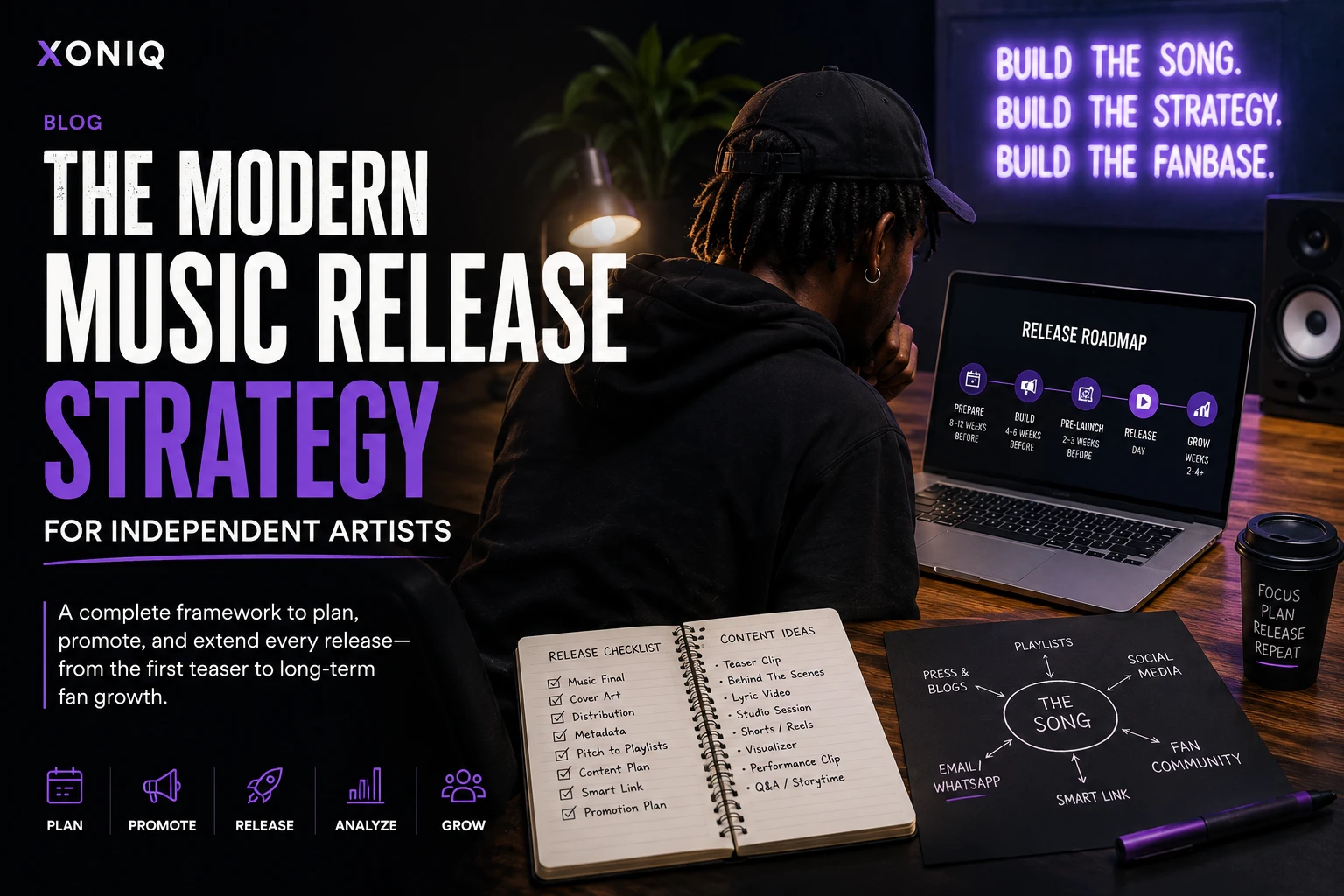
The exact timeline will vary depending on the artist, release and promotional budget, but a useful framework is:
| Period | Main objective |
| 6–8 weeks before | Finalize release and strategy |
| 4–6 weeks before | Begin building anticipation |
| 2–3 weeks before | Increase content and audience activity |
| 1 week before | Finalize platform preparation and promotion |
| Release day | Concentrate attention |
| Week 1 | Maximize engagement and discovery |
| Weeks 2–4+ | Extend the campaign and analyze results |
The important part isn’t following these numbers religiously.
It’s creating enough runway for people to encounter the song more than once.
4. Build a Story Around the Release
People don’t necessarily connect with a song because they know its title.
They connect because something about it makes them curious.
Maybe the song was written after a breakup.
Maybe it represents a completely different sound for the artist.
Maybe it samples something unexpected.
Maybe it was recorded in a bedroom.
Maybe the artist spent six months perfecting the production.
Maybe there’s a visual world surrounding the song.
The story doesn’t have to be dramatic.
It simply needs to give the audience context.
Instead of only saying:
“My new single drops Friday.”
you can give people reasons to care:
- Why did you make it?
- What inspired it?
- What does the song mean?
- What’s happening in the music video?
- What lyric matters most?
- What happened during recording?
- What makes this release different from your previous one?
This turns promotion from advertising into storytelling.
And storytelling gives you significantly more content to work with.
5. Don’t Wait Until Release Day to Create Content
Your promotional content should exist before the song goes live.
That doesn’t mean posting the entire song everywhere.
It means creating curiosity.
For example, one song can produce:
- A short performance clip
- A studio video
- A lyric teaser
- A behind-the-scenes clip
- A story explaining the song
- A snippet of the chorus
- A visualizer
- A reaction video
- A producer breakdown
- A music-video teaser
- A personal story connected to the song
- A countdown post
The objective isn’t to make every post look like an advertisement.
It’s to make the song increasingly familiar.
By the time release day arrives, your audience should already recognize the title, sound, artwork or story surrounding it.
YouTube’s artist resources similarly separate release activity into pre-release, release-day and post-release strategies, reinforcing the idea that promotion is an ongoing process rather than a single announcement.
6. Make Discovery Easy
Imagine someone sees your song on TikTok.
They like the snippet.
They want to hear the full version.
Now what?
If finding the song requires them to:
- Search your name
- Find the correct artist
- Search the song
- Determine which result is legitimate
- Choose their streaming platform
you’ve introduced unnecessary friction.
The fewer steps between interest and listening, the better.
This is where a centralized music link becomes useful.
Instead of asking people to search for you everywhere, you can give them one destination containing the relevant platforms and information about the release.
That’s particularly useful when you’re promoting across Instagram, TikTok, YouTube, X, WhatsApp, websites and other channels.
The principle is simple:
Don’t make interested listeners work to become listeners.
7. Use Streaming Platforms as Part of the Campaign, Not the Entire Campaign
Spotify, Apple Music, YouTube Music and other streaming services are distribution and discovery destinations.
They aren’t necessarily your entire marketing strategy.
Spotify provides artists with profile customization, analytics and editorial pitching through Spotify for Artists.
Artists should take advantage of those tools, but they should also think beyond the streaming platform.
Your audience may discover you through:
- TikTok
- YouTube
- Search
- Blogs
- Playlists
- Creator content
- Live performances
- Collaborations
- Friends sharing music
Your job is to connect those discovery points to the actual music.
Think of the ecosystem like this:
Discovery → Interest → Click → Listen → Follow → Fan
The streaming platform handles part of that journey.
Your release strategy should handle the rest.
8. Pitch Your Music Properly
If you’re releasing on Spotify, don’t ignore Spotify for Artists.
Spotify currently recommends that artists pitch an unreleased song to playlist editors at least seven days before release.
The pitch should provide useful context rather than simply saying:
“Please playlist my song.”
Explain the music accurately.
Consider:
- Genre
- Subgenre
- Mood
- Instrumentation
- Cultural context
- Location
- Story behind the song
- Collaborators
- Promotional plans
Spotify’s own guidance emphasizes that context around the track can help editors understand where it fits.
And remember:
Editorial pitching is not a guarantee of placement.
The purpose is to give your release an opportunity to be considered—not to manufacture a guaranteed result.
9. Release Day Should Be a Concentration of Attention
When the song goes live, don’t treat it like the beginning of promotion.
It’s the moment when all the preparation comes together.
Your audience should be able to encounter the release in multiple places.
That could include:
- Your artist profiles
- Short-form video
- Stories
- YouTube
- Your website
- Your music link
- Email or direct messaging
- Creator collaborations
- Press coverage
- Communities where you already participate
But there’s an important distinction:
Don’t post the same announcement everywhere and call that a campaign.
Adapt the message to the platform.
A TikTok might focus on the strongest moment of the song.
An Instagram post might focus on the artwork and story.
A YouTube Short might focus on the visual.
A personal message might explain why the song matters to you.
Same release.
Different entry points.
10. The First 72 Hours Matter—But Don’t Obsess Over Them
Artists understandably become obsessed with their first-day numbers.
How many streams?
How many followers?
Did the song get playlisted?
How many people clicked?
Those numbers can be useful, but they shouldn’t become the entire definition of success.
Instead, look for signals.
Are people:
- Saving the song?
- Sharing it?
- Commenting?
- Watching the content repeatedly?
- Following you?
- Clicking through from your promotional channels?
- Listening to other songs?
- Creating their own content?
- Returning after the initial discovery?
A release with modest first-day numbers but strong audience engagement can have more long-term potential than a release that produces a large spike and then immediately collapses.
The goal is not merely attention.
It’s retention.
11. Don’t Kill the Song After One Week
This is where many independent artists lose momentum.
They spend weeks preparing a release.
Release day arrives.
They post aggressively for two or three days.
The numbers aren’t immediately huge.
Then they move on.
But people don’t all discover music at the same time.
Someone might discover your song three weeks after release.
Someone might hear it because a creator used it.
Someone might find the artist through another song.
Someone might encounter a lyric video months later.
That’s why post-release promotion matters.
Instead of asking:
“Did this song blow up?”
ask:
“What can I learn from this song, and where else can I take it?”
A single release can generate weeks or months of content.
12. Let the Audience Tell You What to Promote
One of the biggest advantages independent artists have today is access to data.
You don’t have to guess blindly.
Look at what people respond to.
Maybe the chorus consistently performs better than the verse.
Maybe one lyric generates more comments.
Maybe listeners from a particular country are disproportionately engaging.
Maybe a specific video format performs better.
Maybe your audience responds strongly to acoustic versions.
Maybe people are discovering the song through one platform more than another.
Those signals should influence your next move.
If one piece of content is outperforming everything else, don’t immediately abandon it because you’ve already posted it.
Build on it.
Make another version.
Explain the story behind it.
Perform it differently.
Turn the comment section into content.
Use another section of the song.
The best release campaigns become iterative.
13. Build an Audience, Not Just Streams
Streams are important.
But a stream doesn’t necessarily create a fan.
A follower, subscriber, email subscriber, community member or person who repeatedly engages with your work represents a deeper relationship.
That’s why independent artists should think beyond:
“How do I get people to stream this song?”
and start asking:
“How do I turn someone who discovered this song into someone who cares about my next release?”
That distinction changes the strategy.
You aren’t marketing one song.
You’re building an audience for the artist.
14. Think About the Next Release Before the Current One Ends
Your releases should connect.
If you are consistently releasing music, every campaign becomes part of a larger artist narrative.
That doesn’t mean you need to release a new single every few weeks.
It means you should understand where each release fits.
For example:
Single 1 → establishes a sound
Single 2 → expands the audience
Single 3 → introduces a new dimension
EP → brings the story together
This gives your audience a reason to continue following the artist.
You’re no longer throwing individual songs into the internet.
You’re building a catalog and a narrative.
15. A Better Way to Think About the Modern Release
The old model looked something like this:
Create → Upload → Announce → Hope
The modern independent model is closer to:
Create → Prepare → Build anticipation → Release → Measure → Iterate → Extend → Retain → Repeat
That difference is enormous.
The artist is no longer simply responsible for making music.
They are also managing a small media ecosystem.
They are the artist.
The marketer.
The content creator.
The publisher.
The analyst.
The brand.
And increasingly, the direct connection between the music and the audience.
Technology makes all of this possible—but technology doesn’t replace strategy.
The Modern Independent Artist Release Framework
If you want something simple enough to repeat for every release, use this framework:
Before release
1. Finish the music.
Master, metadata, artwork and credits should be ready.
2. Choose the release date.
Give yourself enough time to prepare properly.
3. Build your campaign.
Decide what story, content and visual identity will surround the release.
4. Prepare your distribution and artist profiles.
5. Pitch where appropriate.
For Spotify, submit your unreleased track through Spotify for Artists at least seven days before release.
6. Start building anticipation.
Release week
7. Make discovery easy.
8. Publish your strongest content.
9. Send people to the music.
10. Engage with the people who respond.
After release
11. Study the data.
12. Identify what is working.
13. Create more content around those signals.
14. Continue promoting the song.
15. Turn listeners into followers and fans.
16. Feed what you learned into the next release.
The Biggest Mistake Is Thinking the Song Is the Campaign
Your music is the product.
The release campaign is the system that helps people discover it.
An independent artist doesn’t necessarily need a major-label marketing budget to build momentum.
They need a good song, a clear identity, enough preparation, consistent execution and a system for turning attention into long-term audience growth.
The artists who understand that distinction will have an advantage.
Because in a world where almost anyone can distribute a song globally, distribution is no longer the difficult part.
Getting the right people to discover the music—and giving them a reason to stay—is the real challenge.
And that’s what a modern music release strategy is designed to solve.