You finished the song.
The mix is done. The master is approved. The artwork is ready. You have uploaded everything through your distributor, selected a release date, and submitted the track.
Then you wait.
But what happens after you upload a song to Spotify?
Uploading the song is only the beginning of its journey.
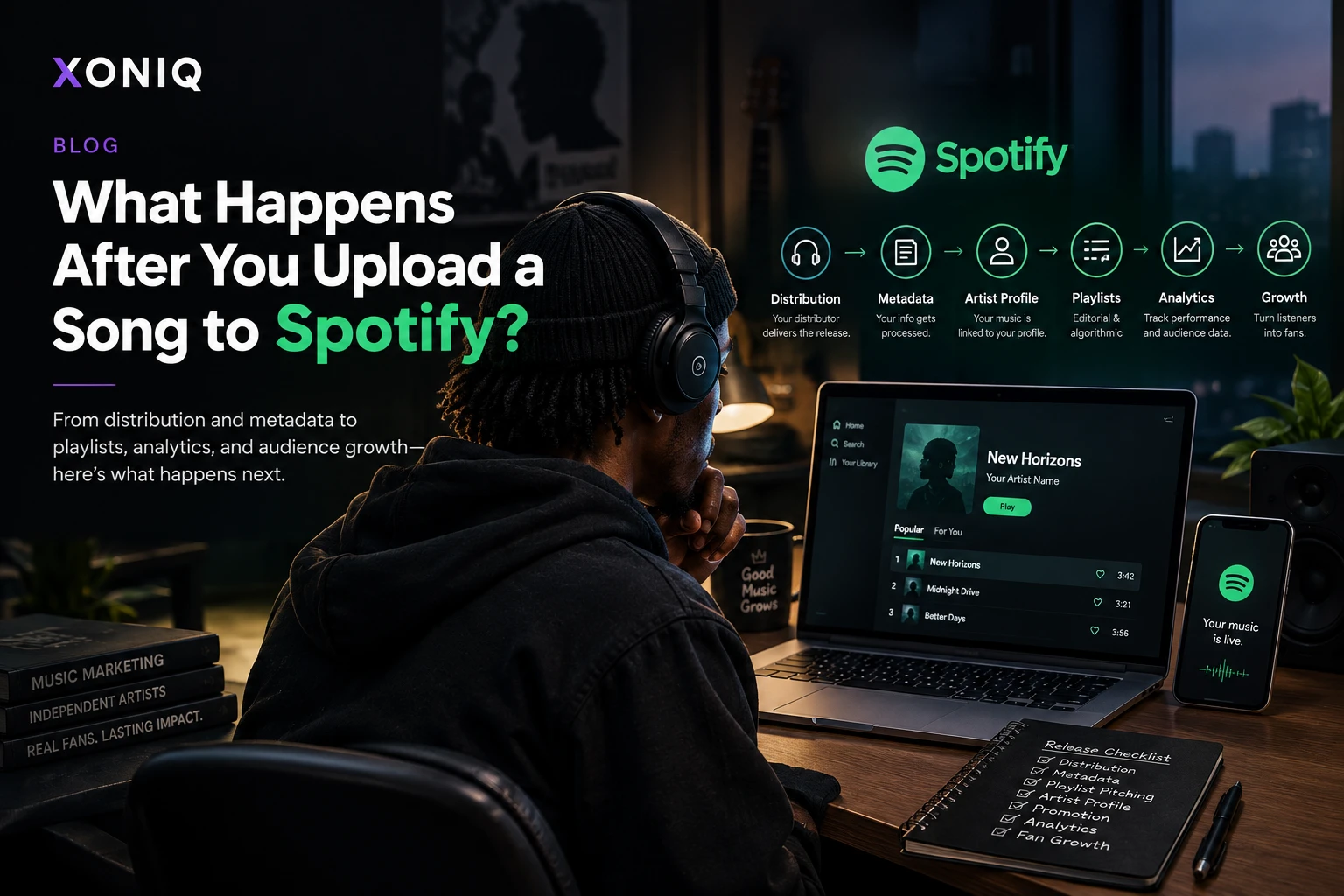
Before listeners can discover it, several things happen behind the scenes. Your distributor delivers the release, Spotify processes the information, your music is connected to an artist profile, your metadata determines how the release appears, and—if you prepare properly—you can begin promoting the song before it is even available to listeners.
Once the song goes live, another phase begins: playlist consideration, audience discovery, analytics, social promotion, and long-term catalog growth.
Understanding this process gives independent artists a major advantage because you can prepare for each stage instead of simply uploading a song and hoping something happens.
1. Your Distributor Delivers the Music to Spotify
The first thing that happens after you upload your song isn’t actually happening on Spotify.
Your distributor is responsible for delivering the release.
Spotify says music is uploaded through a distributor, which handles distribution to Spotify and other streaming services and pays royalties according to the relevant agreements. (Spotify for Artists)
Your distributor typically sends Spotify the audio files, artwork and release metadata.
That information can include:
- Artist name
- Song title
- Album or EP title
- Release date
- Featured artists
- Songwriters
- Producers
- Credits
- Genre
- Copyright information
- Cover artwork
- ISRC and other identifiers
This is why the upload stage deserves more attention than simply selecting an audio file.
A mistake in the information you submit can follow the release onto the streaming platform.
2. Spotify Processes Your Release
Once Spotify receives the release from your distributor, it processes the information and prepares the music for its platform.
Your distributor and Spotify aren’t simply moving an MP3 from one place to another.
The release has to be associated with the correct artist, title, credits and other metadata.
Spotify’s metadata guidelines explain that the platform displays music according to the metadata delivered by the label or distributor. If something needs to be corrected, the distributor generally needs to send an updated version. (Spotify)
This is one reason artists should double-check everything before submitting a release.
Pay particular attention to your artist name
If another artist has a similar name, an incorrect artist association can cause serious problems.
In 2026, Spotify introduced Artist Profile Protection in beta to give eligible artists more control over releases delivered to their profiles. Spotify specifically points to issues such as metadata mistakes, artists sharing names and unauthorized releases as reasons for the feature. (Spotify for Artists)
For independent artists, this reinforces an important lesson:
Your artist identity is part of your music infrastructure.
3. Your Spotify Artist Profile Is Created or Updated
If this is your first release, Spotify automatically creates an artist profile when your music is delivered to the platform.
You don’t manually create the initial artist profile yourself.
Spotify explains that artists can claim the profile through Spotify for Artists once their music has been delivered, and distributors can provide the artist link needed to claim it before the first release goes live. (Spotify)
Once you have access to Spotify for Artists, you can manage important parts of your presence.
That includes things such as:
- Profile images
- Biography
- Social links
- Artist Pick
- Playlists
- Merch integrations
- Performance data
- Audience information
This means your artist profile should not be treated as an afterthought.
Someone who discovers your song may immediately visit your profile.
If they arrive to find an incomplete page, outdated imagery and no clear indication of who you are, you’ve lost an opportunity.
4. Your Metadata Determines How the Release Appears
Metadata sounds technical, but it directly affects how your music is presented.
Imagine two releases.
One contains accurate artist names, properly formatted titles, correct credits and consistent information.
The other has inconsistent artist names, incorrect roles and mistakes in the release information.
The second release can create unnecessary complications.
Spotify’s current metadata guidance specifically emphasizes consistent artist-name formatting and accurate artist roles. (Spotify)
For an independent artist, this means metadata should be treated as part of the release—not as paperwork that someone else can worry about later.
Your music may be heard by millions of people eventually, but the first thing the platforms receive is structured information.
Get that foundation right.
5. You Can Prepare Your Spotify Profile Before Release Day
One of the biggest misconceptions about releasing music is that you need to wait until the song is live before doing anything on Spotify.
You don’t.
Spotify for Artists allows artists to prepare their profiles and release campaigns ahead of launch.
Spotify recommends optimizing your artist profile, preparing visuals, pitching unreleased music to playlist editors and setting up Canvas ahead of release. (Spotify for Artists)
That gives you an important window.
Instead of:
Upload → Wait → Release → Start marketing
you can work with:
Upload → Prepare → Pitch → Build anticipation → Release
That difference can significantly improve how organized your campaign feels.
6. You Can Pitch Your Unreleased Song for Playlist Consideration
If you’re hoping to reach Spotify’s editorial playlists, the opportunity comes before release.
Spotify for Artists includes a playlist pitching tool that allows artists to submit an unreleased track for editorial consideration.
Spotify currently recommends pitching the focus track at least two weeks before release on its new-release guidance, while some Spotify guidance has historically referenced at least seven days. The safest approach is therefore to submit as early as possible rather than waiting until the final week. (Spotify for Artists)
The pitch provides context about the release.
Depending on the submission, you may provide information about:
- Genre
- Mood
- Sound
- Story
- Cultural context
- Location
- Instrumentation
- Release details
This information helps Spotify’s editorial team understand the music.
But there is an important distinction:
Pitching does not guarantee playlist placement.
No legitimate process should promise that paying someone will get your song onto an official Spotify editorial playlist.
Spotify explicitly states that editorial playlists are not available for purchase. (Spotify for Artists)
7. Your Release Can Become Eligible for Personalized Discovery
Editorial playlists aren’t the only way listeners discover music on Spotify.
Spotify also has personalized experiences such as Release Radar and other recommendation systems.
Building followers matters because your existing audience can become part of the initial discovery network around a release.
Spotify’s artist guidance encourages artists to grow their followers because followers can receive new releases through personalized Spotify experiences. (Spotify for Artists)
This creates an important principle:
Your previous release campaign can help your next release.
If someone discovers your music today and follows you, that relationship can become valuable when you release your next song.
You’re not just collecting streams.
You’re building an audience.
8. Your Song Goes Live
Eventually, the release date arrives.
Your song becomes available to listeners.
At this point, your distributor’s job is largely about delivery.
Your job as an artist is about activation.
This is when the campaign you’ve been preparing should become visible across your channels.
You might share:
- The Spotify link
- A smart link
- Short-form videos
- Lyric clips
- Behind-the-scenes footage
- Music-video content
- Artwork
- Performance clips
- Stories
- Direct messages
- Press coverage
- Creator collaborations
The important thing is to make the path from discovery to listening simple.
Someone sees your video.
They become curious.
They click.
They find the song.
They listen.
That journey should have as little friction as possible.
9. Spotify Starts Giving You Data
Once people begin listening, Spotify for Artists becomes one of your most useful tools.
Instead of asking whether people like your song, you can begin looking at actual audience behavior.
Spotify provides artists with performance and audience insights through Spotify for Artists. (Spotify for Artists)
Depending on the available analytics, you can learn things such as:
- How your music is performing
- Where your listeners are located
- How people discover your music
- How many listeners are returning
- How your followers are engaging
- Which songs are attracting attention
This is where the release changes from a creative project into a measurable campaign.
You can begin asking better questions.
Where are my listeners coming from?
Which song is attracting the most attention?
Are people returning?
Which content is driving people toward the music?
What should I do differently next time?
Those answers can influence your next release.
10. Don’t Judge the Song Only by Its First Day
One of the worst habits an independent artist can develop is checking the stream count every few minutes after release.
A first-day number can be useful.
It is not the whole story.
Spotify has previously highlighted that a substantial proportion of a release’s first-year streams can occur after the first month, illustrating why artists shouldn’t assume that the first few days determine the entire life of a song. (Spotify for Artists)
A song can find an audience gradually.
Someone might discover it through a playlist weeks later.
A creator might use the song in a video.
A listener might discover your artist through another track.
A blog might feature the release.
A performance clip might suddenly take off.
This is why post-release promotion matters.
11. Keep Promoting the Song After Release Day
Your release doesn’t become irrelevant because it is no longer “new.”
In fact, you now have something you didn’t have before release:
real audience data.
You can use that information to create better content.
If listeners respond strongly to the chorus, make more content around it.
If a lyric generates comments, explore that lyric.
If an acoustic performance performs better than expected, create another version.
If people are discovering the song through a particular platform, invest more attention there.
The post-release phase is essentially an experiment.
You release.
You observe.
You learn.
You adjust.
Then you repeat.
12. Spotify Isn’t the Entire Release Strategy
Spotify is an important destination for music, but it shouldn’t be the entire ecosystem surrounding your release.
Your audience can discover you through:
- TikTok
- YouTube
- Search
- Blogs
- Playlists
- Live performances
- Collaborations
- Communities
- Other streaming platforms
This is why independent artists should think in terms of distribution plus discovery.
Spotify helps people listen.
Your broader marketing system helps people find you.
A smart link can be useful here because one destination can direct listeners toward the platform they already use instead of forcing everyone to search manually.
That’s particularly valuable when you’re sharing a release across multiple platforms.
13. Your Song Can Continue Working for You
A release doesn’t have to stop producing value when the initial campaign ends.
Your song can become:
- A short-form content soundtrack
- A performance piece
- A live-show moment
- A playlist entry
- A catalog discovery point
- A collaboration opportunity
- A promotional asset
- A gateway to your older music
Think about your catalog as a connected system.
Someone discovers your newest single.
They visit your profile.
They find your previous release.
They listen to your EP.
They follow you.
Then, when your next song arrives, you’ve already built part of the audience for it.
That’s the difference between promoting a song and building an artist career.
14. What If Something Goes Wrong?
Not every release will go perfectly.
You might notice:
- Your song is on the wrong artist profile
- Your artist name is formatted incorrectly
- A credit is missing
- The artwork is wrong
- A release date is incorrect
- A collaborator isn’t properly associated
- Your song isn’t appearing where expected
Don’t try to solve every problem directly inside Spotify.
Many release-level corrections have to go through the distributor or label that delivered the metadata.
Spotify’s metadata guidance specifically says that corrections generally need to be sent through the label or distributor. (Spotify)
This is another reason to choose your distributor carefully and keep your release information organized.
15. The Real Journey of a Spotify Release
So, what happens after you upload a song to Spotify?
The simplified journey looks like this:
1. You finish the music
↓
2. You upload it through a distributor
↓
3. The distributor delivers the release to Spotify
↓
4. Spotify processes the audio, artwork and metadata
↓
5. Your release is associated with your artist profile
↓
6. You prepare your Spotify for Artists profile
↓
7. You pitch the unreleased track if appropriate
↓
8. You build anticipation outside Spotify
↓
9. The song goes live
↓
10. Listeners discover and stream it
↓
11. Spotify generates performance and audience data
↓
12. You analyze the results
↓
13. You continue promoting the song
↓
14. You use what you learned to improve the next release
The upload itself is only one step in that entire process.
What Independent Artists Should Do After Uploading a Song
If you’ve just uploaded your next release, use this checklist:
Before release
- Verify your metadata.
- Confirm the correct artist profile.
- Claim or access Spotify for Artists.
- Complete your artist profile.
- Prepare your release artwork and promotional assets.
- Pitch your unreleased track for editorial consideration.
- Add Canvas or other available visuals.
- Prepare your social content.
- Create your music link.
- Start building anticipation.
On release day
- Confirm the song is live.
- Check that the artist profile and metadata are correct.
- Share the release.
- Send listeners directly to the music.
- Publish your strongest promotional content.
- Encourage your audience to follow you.
- Engage with people responding to the release.
After release
- Monitor performance.
- Identify your strongest discovery sources.
- Study audience behavior.
- Continue creating content.
- Reuse successful creative angles.
- Keep promoting the song.
- Build your follower base.
- Apply the lessons to your next release.
Your Upload Is Not the Finish Line
Uploading a song to Spotify can feel like the final step because you’ve spent months making the music.
It isn’t.
It’s the moment when your music enters a much larger ecosystem.
The distributor gets the release where it needs to go.
Spotify processes the release and makes it available to listeners.
Your artist profile gives people a place to learn more about you.
Playlists and recommendation systems can help with discovery.
Analytics show you what is happening.
But none of those things replace the artist’s responsibility to create awareness and build an audience.
The most important thing to understand is simple:
Uploading the song makes it available. Your release strategy gives people a reason to find it.
And once they find it, your job is to give them a reason to stay.
That is how a single Spotify release becomes part of a much bigger independent music career.